The precautionary principle in the European Union
From eloquent speech to disappointment
The EU Council of Ministers has adopted a recommendation for 'high-level protection against the acute effects of electromagnetic fields (EMFs) in the 0 Hz to 300 GHz range.' Protection against all other than acute effects must then be provided in accordance with the precautionary principle, as explicitly stated in the Treaty on the Functioning of the European Union. The following describes the precautionary principle, when it should be applied, and the risk assessment that should form the basis for its application.
The precautionary principle was first mentioned in an EU treaty in the Single European Act of 1986. However, it was not referred to by this name, but 'preventive action'.1
The current wording of the precautionary principle was set out in Article 130r of the Maastricht Treaty of 1992.
Community policy on the environment shall aim at a high level of protection taking into account the diversity of situations in the various regions of the Community. It shall be based on the precautionary principle and on the principles that preventive action should be taken, that environmental damage should as a priority be rectified at source and that the polluter should pay.
Since then, Article 130r became Article 174, which is now Article 191, and 'Community' has changed to 'Union' following the European Community's transformation into the European Union.2
The Commission explains
The text quoted above is the only part of the Treaty on the Functioning of the European Union that describes the precautionary principle. In February 2000, the Commission published its interpretation of how the principle should be applied. Below are some quotes from the introduction.
The precautionary principle, which is essentially used by decision-makers in the management of risk, should not be confused with the element of caution that scientists apply in their assessment of scientific data.
The implementation of an approach based on the precautionary principle should start with a scientific evaluation, as complete as possible, and where possible, identifying at each stage the degree of scientific uncertainty.
Decision-makers need to be aware of the degree of uncertainty attached to the results of the evaluation of the available scientific information. Judging what is an "acceptable" level of risk for society is an eminently political responsibility. Decision-makers faced with an unacceptable risk, scientific uncertainty and public concerns have a duty to find answers. Therefore, all these factors have to be taken into consideration.3
The European Parliament has no decision-making power over when and how the precautionary principle should be applied. It adopted a resolution stating that a high level of health and consumer protection must be ensured, and calling for political support for the Commission's communication.4 The support was given in Nice in December 2000.
Nice 7-10 December 2000
The main features of the application of the precautionary principle were outlined when the European Council — the EU's highest decision-making body, consisting of the heads of state and government of the member states — met in Nice. Some of the key points are as follows:
10. Considers that an assessment of risk must also report any minority opinions. It must be possible to express such opinions and bring them to the knowledge of the parties involved, in particular if they draw attention to scientific uncertainty;
11. Affirms that those responsible for scientific assessment of risk must be functionally separate from those responsible for risk management, albeit with ongoing exchange between them;
14. Considers that all stages must be conducted in a transparent manner, in particular the risk assessment and management stages, including the monitoring of measures decided upon;5
In short, the precautionary principle relies on impartial evaluations of scientific reports and their indication of risk probability. Without these evaluations, the principle cannot be implemented.
The best example of a basis for applying the precautionary principle that we have found does not come from the EU or one of its member states, but from California.
California
The final report of The California EMF Risk Evaluation for Policymakers and the Public was published in June 2002. Three researchers from the California Department of Health Services (DHS) followed a clearly defined process to reach a decision that was presented in both everyday English and graphs. Their decisions were reported individually.
From the Executive summary
To one degree or another, all three of the DHS scientists are inclined to believe that EMFs can cause some degree of increased risk of childhood leukemia, adult brain cancer, Lou Gehrig’s Disease (ALS), and miscarriage.6
Using an 'x' on a scale from zero to one hundred the three researchers indicated their assessment of the extent to which the risks identified by the research were also 'real' risks. The shaded bar surrounding the 'x' shows the uncertainty in their assessment (see graph below). The numbers were also translated into everyday English.7
'Real' risks?
Can science discover a risk that doesn't actually exist? Of course not. In risk assessment, a risk is considered real if there is convincing or conclusive evidence that it exists. Otherwise it is not.
Miscarriage graph

People assess the same thing differently, and the reviewers' conclusions were reported individually.
To improve transparency in the decision-making process, the researchers also had to answer a series of predefined questions to establish a level of certainty regarding causality. Below are four examples related to probability:
Chance: How likely is it that the combined association from all the studies of EMF and disease is due to chance alone?
Bias: How sure are the reviewers that EMFs caused this pattern, rather than a study flaw? If there's no bias explanation, how sure are they that EMFs caused these associations and not flaws? [Bias is a factor that distorts results in a certain direction. Our comment]
Confounding: What are the reviewers' thoughts on the disease associations being due to EMFs and not another risk factor? If not due to a specified risk factor, how convinced are they that they are due to EMFs rather than unspecified risk factors? [A confounding factor distorts the result. Our comment].
Combined effect: How sure are the reviewers that these disease links are due to EMFs and not chance, bias and confounders?8
One question that has a significant impact on risk assessment is how much weight should be given to different types of research.
The three DHS scientists believed that there were reasons why animal and test tube experiments might have failed to detect a mechanism or health issue. Consequently, the lack of support from such studies did not significantly diminish their confidence or cause them to distrust epidemiological evidence from statistical studies in human populations. They therefore had more faith in the quality of epidemiological studies and gave them more credence.9
Personal opinion is not insignificant, and even researchers have different views. Therefore, the researchers' initial opinions were presented before the evaluation work began, along with any changes during the course of the work.10
SCHEER
On request of the Commission in the European Union, the Scientific Committee on Health, Environmental and Emerging Risks (SCHEER, former SCENIHR and before that SSC and even earlier CSTEE) provides the answer.11 The Commission's secretariat then summarises the committees' conclusions in fact sheets for the general public.12
The latest assessment of potential risks to the general public from magnetic fields associated with the electricity grid and electrical appliances, and from radiofrequency radiation associated with wireless technology, was published in 2015. The 2024 assessment focuses on working life.
For the general public
The Commission's summary for the general public of the 2015 SCENIHR report is just two sentences long.
Thorough examination of all pertinent, recent data has not produced any conclusive evidence about EMF being dangerous, which is reassuring. However, further research should be conducted, particularly as pertains to very long-term exposure and potential risks of exposure to multiple sources.13
The Executive summary
The assessments of risks conclude with phrases such as 'little consistency between studies', 'provide little evidence', 'prevent a causal interpretation' and 'suggest implausible effects'. The phrase 'strong evidence' was used when the majority of studies showed no effect, which was interpreted as there is no effect. This is in contrast to the golden rule in science, which states that absence of proof is not proof of absence. The reason is that, when we expand our area of knowledge, there are many more ways to do research wrong than right.
Rules of Procedure
The instructions for committees working on health issues for the EU are set out in the Rules of Procedure 2016.
The meaning of the scientific advice, the way conclusions were drawn, the limits of their validity and the relevant uncertainties must be clear and understandable for users, relevant stakeholders and the public.14
It seems that the instructions necessary for a report such as the one from California have been provided. However, the Rules of Procedure does not ask scientists for their opinion on whether or not they are prone to believe or not believe in an effect. The Rules of Procedure as well as the Committee, when following the outlined instructions, abandon the reader halfway through by failing to indicate whether there is probably no risk or a possible, probable or scientifically proven risk.
What does 'prevent a causal interpretation' mean in terms of the probability of risk? The precautionary principle is not about establishing the cause of a disease, but rather about assessing the degree of scientific certainty of causality.
Scientific certainty
If the aim of the 2015 work was to evaluate the extent to which the risks are scientifically proven, it has failed. The Californian evaluation's efforts to describe the scientific certainty of the assessments as clearly and transparently as possible is lacking. As is evident from the public summary, action is only demanded by conclusive evidence—recent data has not produced any conclusive evidence about EMF being dangerous. Therefore, SCENIHR's opinion on Potential health effects of exposure to electromagnetic fields is not useful for the application of the precautionary principle.15
The Commissions mandate
There are high expectations that SCHEER will lay the groundwork for applying the precautionary principle. However, SCHEER does not take any initiatives of its own; the committees instead work under the Commission's mandate.16 The Commission's mandate and terms of reference state the questions that begin a process of assessing possible health risks associated with electromagnetic fields.
Every opinion issued by SCHEER responds to a question from the Commission regarding whether new research could alter the conclusions of previous opinion. SCHEER and its predecessors have issued opinions in 2001, 2007, 2009, 2015 and 2024,17 all of which conclude that the previous assessment does not need to be changed. The question could not always have been about the previous opinion, so which was the first? This chain began with an opinion issued by the Scientific Steering Committee (SSC) in 1998, which had to answer these questions:
A. An opinion on non-thermal, long-term health effects of exposure to EMFs, in particular addressing epidemiological evidence and also biophysical and biological evidence on genetic and cancer-related effects, effects on the immune system and effects on the nervous system. The opinion should indicate whether any recommendations for exposure limits can be made, and
B. an opinion on whether for thermal effects, the scientific advice of the International Commission on Non-Ionising Radiation Protection (ICNIRP) is the appropriate basis for a system of health protection against risks from non-ionising radiation.
The answer to question A was 'NO'. No limits could be recommended for biological effects. Note that the commission asked about limits, not whether the aforementioned biological effects exist. It must have been obvious to the European Commission that they do.
Question B did not ask whether thermal effects are an appropriate basis for health protection. Instead, it asked whether the ICNIRP guidelines are appropriate for protecting against thermal effects.18 They are. This left the Scientific Steering Committee with no option. Question B was answered 'YES', thus granting scientific approval to the commission's proposal.
In 1999, once the SSC had issued its opinion, the Council of Ministers made the political decision to recommend the ICNIRP guidelines for protection against acute effects, referring to the Scientific Steering Committee. This set the level of protection for the general public.
The Commission's repeated question to SCHEER as to whether the previous opinion needs to be changed in light of new evidence, and the chain of opinions that began in 1998, raises three questions. Firstly, why is new research the only consideration rather than all research? Secondly, why has the 1998 question about exposure limits been omitted? Thirdly, why is the precautionary principle never mentioned in this context?
Through the formulation of the Commission's question to the SCHEER committees, the committees have never been tasked with assessing the possible or probable health risks of electromagnetic fields. They have been tasked with looking for research that points to the need for a lower limit for immediate effects.
The Treaty on the Functioning of the European Union states that protection 'shall be based on the precautionary principle', which in turn is based on a correct assessment of possible or probable health risks.
Politicians set the limits for what officials in the Commission can do. These officials then ask researchers questions, and the answers determine how politicians should act. This raises the question: who is really in control here?
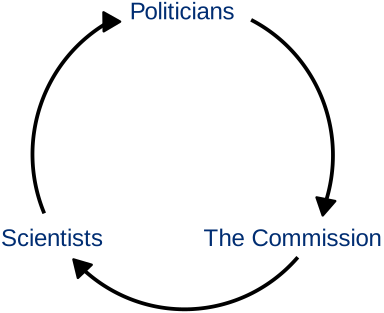
Of course, it is the politicians who hold the reins of power. The question is: what is their most important aim?
Separating science from politics
'Thinking European, and
winning the wireless race'
This was the headline of a speech delivered by Neelie Kroes, the Vice-President of the European Commission responsible for the Digital Agenda in 2013.19 How does the precautionary principle measure up against winning the wireless race?
In Nice 2000 the European Council concluded that 'an assessment of risk must also report any minority opinions'. How are the majority and minority defined?
Is the answer to a scientific question really a matter of majority and minority, rather than right or wrong? In his book, The Electric Wilderness, the researcher Andrew Marino describes his experiences of participating in a hearing, together with Robert Becker, on the health risks of power lines. It's a story of a fight against the electric power industry, New York State, federal regulatory agencies, and the military. Marino's support for those at risk goes without saying, and he describes a method for separating science from politics.
A science court
The dispute would be openly admitted and the values involved separated from the scientific questions. The science court would decide the scientific questions alone. Each side would prepare clear scientific statements, and the case would be tried by a panel of scientist-judges. These judges would be experts in areas external to the dispute. The two sides would be given the opportunity to cross-examine the other and the whole process would be open to the public.
Interest in a scientific court to separate science from politics had been raised at presidential level, resulting in the appointment of a working group. One of the group's members wanted to test the idea on the controversy over the effects of electromagnetic fields from power lines. Andrew Marino and Robert Becker agreed to participate, but those who claimed there was no risk, did not.20
How do they know?
The most important question to ask the researchers who assess the risks is 'How do you know?' They must explain how this was done in a way that is as easy as possible to understand for politicians and other non-specialists. This is a democratic issue.
Transparency
The California reviewers added questions they had to answer to improve transparency about probabilities and a number of others on their own initiative. Although they are referred to as reviewers, researchers or scientists, they were also employed as civil servants by the California Department of Health Services. Four of their added questions are cited above.
The DHS scientists found the usual process of describing the pattern of evidence in some detail and then expressing an opinion (without explaining the rationale for that opinion) to be insufficiently transparent. Accordingly, they supplement the usual IARC procedure with an additional form of presentation and an additional form of judging whether EMFs are a cause of disease.21
Contradictory or opposing
How are different results evaluated? While physics follow specific laws, the reactions of each living organism follow it's own. Researchers have found that EMF can have a dampening or stimulating effect under the same conditions.22 Should these results be dismissed as contradictory; or opposing and evaluated as demonstrating an effect?
Both SCENIHR and now SCHEER, which have assessed the health risks associated with electromagnetic fields, operate under the remit of the European Food Safety Authority (EFSA). EFSA places great importance on ensuring that research findings are consistent.23 The word 'contradictory' is often used in SCENIHR and SCHEER reports to describe the results of different studies. Following EFSA's guidance, these results are dismissed when assessing the risk.
Precautionary principle applied
The Commission's mandate for SCHEER's 2024 opinion highlights the potential for workers to be granted greater protection than that required by EU minimum requirements, which are five times lower than the protection for the general public. In other words, the exposure limits for workers are five times higher.
Directive 2013/35/EU by 1st July 2016. It lays down minimum requirements including action levels and exposure limit values for electromagnetic fields. In accordance with Article 153 of the TFEU, Member States are allowed to maintain or adopt more stringent protective measures for the protection of workers.24
Is there any scope for applying the precautionary principle? Yes, the Council of the European Union's decision to recommend the ICNIRP exposure limits is merely advisory. According to the Commission's 2008 report, some countries have partly adopted more stringent exposure limits for the general public and not only for workers. These countries included Belgium, the Netherlands, Luxembourg, Italy, Poland, Bulgaria, Slovenia, Greece, Lithuania and Finland. Although not a member state, Switzerland was also mentioned.25 No more recent report could be found.
How high can an exposure limit be without people becoming ill?
Continue reading:
