The peoples verdict
The responsible authorities claim that the exposure limits for electric fields and magnetic fields as well as radio frequency radiation provide adequate protection. However, surveys of the general public have given a completely different outcome.
Do the exposure limits work?
On some occasions, people have been asked whether they experience any discomfort from electrical appliances or wireless technology. It turned out that around one in three respondents experience some degree of discomfort, and almost half reported that their health was adversely affected.
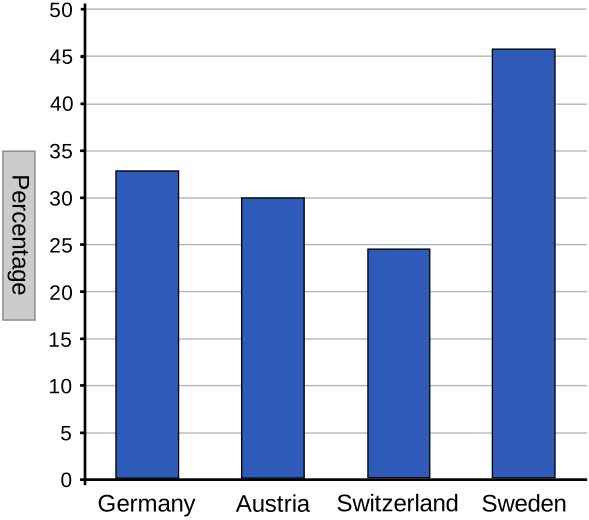
Percentage of the population experiencing discomfort
Germany
In the 2003 survey conducted by the German Federal Office for Radiation Protection (BfS), respondents were free to specify any symptom they experience from electrical appliances or wireless technology. For the 2004 survey, these symptoms were divided into ten categories from which respondents could choose. While 41 per cent of respondents reported one or more symptoms in 2003, this figure fell to 33 per cent in 2004. The four categories containing the most commonly reported symptoms were headaches and migraines, sleep problems, feeling unwell and circulation problems, as well as fatigue, mental health issues and concentration problems.1
Austria
In an Austrian interview survey, 30 per cent of respondents either agreed with or partially agreed with the statement, 'I feel that my well-being is disturbed in the vicinity of power lines or mobile phone masts'. 3.5 per cent had consulted a doctor about their symptoms.2
Switzerland
The land in the middle of the Alps is unique in that it has
precautionary values which are monitored by the authorities.
The EU's recommended limits are 100–150 times higher than
Switzerland's precautionary values. In 2023, 25 per cent of
the Swiss population responded that they had experienced
problems in their local area due to power lines and mobile
phone masts.3 Swizz exposure limits
Sweden
In 2015, the general public in Sweden were asked whether various environmental factors affect health. 5.2 per cent of respondents said that they were disturbed by car exhaust fumes more than once a week. In large cities, 10–12.2 per cent reported being very or extremely disturbed by traffic noise.
Questions about 'electromagnetic fields from, for example, mobile phones and antennas' and 'electromagnetic fields from, for example, electrical appliances and power lines' had been asked too. 4 However, the results were not published as for noise and car exhaust fumes.
Following a request, the results were provided to the The Swedish Association for the Electrohypersensitive. 35.2 per cent of respondents said that their health is negatively affected and 10.6 per cent said that their health is significantly affected by mobile phones and masts. Overall, 45.8 per cent reported a negative or significantly negative impact.5
Are the authorities doing their job?
The European Commission regularly conducts opinion polls on current issues. As part of the Eurobarometer series, two polls on electromagnetic fields have been conducted, with the same questions asked on both occasions in 2007 and 2010.
The people give the authorities a failing grade

One of the questions in the surveys was: 'In your opinion, do public bodies act effectively to protect you from potential health risks linked to electromagnetic fields?' In 2007 and 2010, 60% and 58% respectively answered 'No, not very effectively' or 'No, not at all effectively'. In both years, the average response for 'Yes, very effectively' or 'Yes, fairly effectively' was 25 per cent.6
The European Commission's description of the background to the investigations suggests a certain irritation: 'Over the last decade, not only has the issue of the potential health effects of electromagnetic fields stubbornly remained of concern to a persistent share of the public, but the explosion of mobile telephony and of other wireless technologies has increased its visibility.'7
Do you miss your home country? The full report on the Eurobarometer website presents all results country by country. Eurobarometer
 including
links to full text in German
including
links to full text in German 