How to measure electromagnetic fields
If you know how the meters work, you will get the right measuring, be able to locate sources and get the most out of your meter.
Microwaves
Wi-Fi, mobile phone masts.
Magnetic fields
Unbalanced currents, electric appliances, power lines.
Electric fields
Household electrical systems, cords, cables and appliances.
Body voltage
The impact of electric fields on the human body.
Microwaves


1. Bektas et al. 2020: Comparison of effects of
2.4 GHz Wi-Fi and mobile phone exposure on human
placenta and cord blood,
Biotechnology & Biotechnological Equipment,
34:1, 154-162 .
2. Birks et.al. 2017:
Maternal cell phone use during pregnancy and child
behavior problems – five birth cohorts ,
Environmental International vol. 104, July 2017.
3. Föredrag av Rainer Nyberg, prof.emeritus i
pedagogik, på Vågbrytarens seminarium Hur mår våra
barn? Hur skärmtid kan påverka barns beteende, lärande
och hälsa. Referat i Miljömagasinet nr 49, 2017.
4. Aldal et.al.: Radiation Exposure From
800-1900 Mhz-Rated Cellular Telephones Affects
Neurodevelopment and Behavior in Mice,
Scientific Reports 2, art. nr 312, Mars 2012 .
Se även BabySafeProject.org
Electromagnetic waves, such as radio and microwave waves, consist of an electric field and a magnetic field that are aligned in a specific direction. To achieve maximum sensitivity and provide the highest reading, the antenna in the meter must be aligned in the same direction as the force in the electric field. This direction is called polarisation.
The polarisation of microwaves can vary greatly, but is usually vertical. Hopefully, the meter's instructions or markings will indicate the direction of the receiver antenna.
The meter's antenna

The antenna is typically a straight rod. In order for the antenna to receive radio waves optimally, the electric fields must be parallel to the length of the rod. If the electric fields fall across the rod, reception will be poorer. This type of antenna has no front or back and is sensitive to waves coming from most directions, except directly towards the ends.
Covering the antenna with your hand or fingers will result in a lower measurement. To avoid this, hold the bottom of the meter.

Bearing

Where does the microwave radiation come from? Searching for maximum intensity is more difficult than searching for minimum intensity. When one end of a simple rod antenna is pointed towards the transmitter, the antenna is theoretically completely insensitive. There will be a clear minimum on the meter reading and the speaker may fall silent when one end of the antenna is pointing directly towards the transmitter. With a directional antenna, the tip is pointed towards the source when the measurement value is at its maximum.
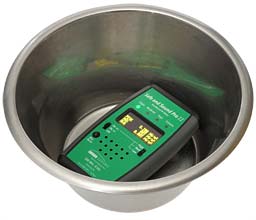
If there are transmitters in multiple directions, it is simpler to use shielding than to try pinpointing their exact locations. A metal bowl or baking tray can be used as an effective screen. No microwaves can pass through such a screen. However, the meter must not be placed directly against the shielding, but rather 5–10 cm away, to allow the meter's antenna to function normally.
Reflection and absorption
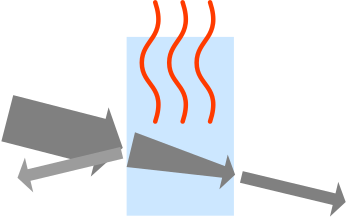
Some of the radiation is reflected off surfaces such as walls, floors and ceilings, as well as off the person holding the meter. Therefore, if you are measuring the general radiation level, hold the meter as far away from your body as possible and measure in the middle of the room. Reflection off metal is total because it is practically impervious to radio and microwave waves.
Through the wall
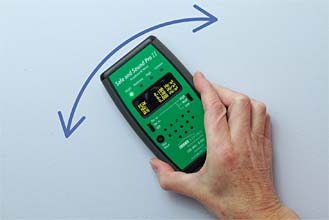
How much energy can pass through a wall, floor, or window with energy-saving glass? It acts as a shield, and this time we want to know how much radiation is getting through. Therefore, hold the meter against the object to be measured. This is the opposite of the example with the bowl above. Different manufacturing processes are used for energy-saving glass, resulting in some types attenuating microwave radiation and others not.
Magnetic fields
Electric currents create magnetic fields

Magnetic fields rotate around a conductor of electric current. If the current flows in the same direction as the thumb on the right hand points, the magnetic fields rotate in the direction of the other fingers. No magnetic fields are created if no current flows through the conductor.
Magnetic fields generate electricity
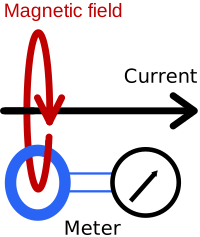
If the strength of the magnetic field changes, a voltage is created in an electrical conductor located in the magnetic field. This phenomenon is used to measure magnetic fields from the electricity grid. The meter contains a coil consisting of many turns of copper wire. A magnetic field passing through the coil creates a voltage in the wires when the strength of the magnetic field varies. But only then. The voltage is created in proportion to the speed of the variation. After a filtering of the voltage it is presented as the strength of the magnetic field. Static magnetic fields whose strength does not vary can also create a current in the coil if it moves through the magnetic field. If the meter is shaken, it is tricked into thinking that the Earth's static magnetic field varies in strength.
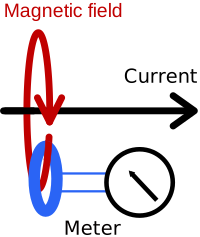
Turning the coil so that the magnetic field runs parallel to it rather than passing through it results in less voltage being generated in the coil, which is indicated by an increasingly weaker reading on the meter. Three-axis magnetic field meters, which measure magnetic fields in three directions, always indicate the maximum strength of the magnetic field.
Locating cables
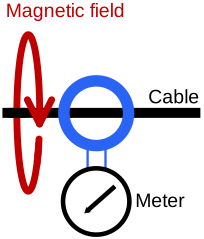
The position of electrical cables can be determined very accurately using either a single-axis magnetic field meter or a three-axis meter that can be set to use only one coil. The coil should then be oriented parallel to the cable. In practice, this means lying flat against the ground or floor. If there is only one cable, the magnetic field meter will show a distinct minimum directly above it.
As high-frequency interference is very common on cables, a longwave radio can be used to locate hidden cables in walls, floors and ceilings indoors. Outdoors, a radio can locate buried cables. Cables without a load and therefore without a magnetic field, can be located using a radio. The radio will become silent when the left or right side is pointing at the cable.
Electric fields

An electric field meter can give surprising results. This is because it always measures the voltage difference between two points, never which point has the highest voltage. For example, if you stand on a power cord, the meter will show high electric fields wherever you point it. In wooden houses, where electric fields are generally higher than in stone houses, the meter will show high electric fields when pointed at grounded cookers and refrigerators that have the electrical system's protective earth level. Instead, it is the person holding the meter who is responsible for the electrical voltage. Not the cooker or refrigerator.
Body voltage
The most cost-effective way to gain an understanding of the electric fields in your home.
In particular, electric fields cause a voltage in the body that can be measured using simple equipment. The only items you may need to purchase are a cord and a multimeter. You can find aluminium foil in the kitchen and clothes pegs in the laundry room.
Ideally, the cord should be flexible and have only one conductor. The multimeter must have sufficiently high internal resistance. Otherwise, too much current will flow through it and in worst case leaving no voltage left to measure. The effect of different internal resistances is shown in the table below.
| Make and model | Type | Volt |
|---|---|---|
| Euratele | Analogue | 0,01 |
| Caltek 4200 | Digital | 4,1 |
| BST BS1704 | Digital | 9,8 |
| Mastech | Digital | 18,0 |
| DCM 6003 | Digital | 12,8 |
The Euratele is an old,
simpler model. The Caltek 4200 dates back to the early
1990s, but is the only one with a declared internal
resistance of 80 megaohm (Mohm). Internal resistance does
not seem to be a problem in modern multimeters.

The reference point
Body voltage is the voltage in the body caused by electric fields from appliances. Having a fixed point against which body voltage can be measured makes this easier. Indoors, this reference point is typically the protective earth of the electrical system, accessible via unpainted metal parts on earthed appliances. The cooker, for example.
If you have a garden, you can use Mother Earth as your reference point. Strip the insulation off a few metres of electrical cable and bury it. Burying it a few inches below the lawn is sufficient; then keep it damp.
Using the protective earth as a reference makes it easier to find the sources of electric fields indoors.

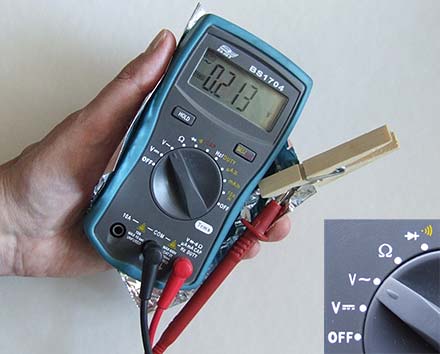
The clothes peg holds the test probe and aluminium foil together. The aluminium foil under the multimeter in your hand ensures good contact between your body and the multimeter's red test probe. Your other hand is then free to explore interesting sources of electric fields. The black cord leads to the reference point.
No scientific studies on health effects have ever measured body voltage. The results also depend heavily on the multimeter used, so it is not possible to specify an acceptable maximum level for voltages measured in fractions of a volt. However, experience shows that body voltages of several volts are clearly unacceptable. This is particularly the case in your bed.
Multimeters typically have a frequency range of between 30 and 2,000 hertz (Hz) and are used to measure the fundamental frequencies of the mains supply, which are 50/60 Hz and 150/180 Hz. A radio is unrivalled for detecting dirty electricity.