Review of EMF meters
The purpose of your first EMF meter is to help you discover the electromagnetic world and identify areas of higher or lower radiation. The most important thing is how easy the meter is to use. However, meters are not accurate enough for two to give the same reading. We have also tested the meters in everyday environments and found that two popular models failed to detect all radiation.
Explanations can be found under the question mark at the bottom right.
Which one to choose?

Tenmars TM-190
This is a small meter that fits in your hand. It has a large display with clear, slowly changing numbers, making it easier to read. It measures electric and magnetic fields, as well as radio and microwave waves. The location of the meter's sensors is marked on the back. Electric fields are only measured on the right-hand side when viewed from the front, so it is important to hold the meter in the correct position relative to the power cord. However, when measuring magnetic fields, you do not need to worry about how you point the meter. That is the beauty of a three-axis magnetic field meter. While the manufacturer does not specify whether the meter displays peak or average values, when compared with other meters it can be concluded that it displays peak values for radio and microwave waves, and average values for electric and magnetic fields. The speaker is only used for key beeps, button clicks, and alarms when radiation exceeds a certain level.
Specifications Tenmars TM-190 |
|
| Electric fields | |
| Frequency range | 50 - 60 Hz |
| Measuring range | 50 - 2000 V/m |
| Peak value | No |
| Accuracy | +/- 7 % +50 digits |
| Magnetic fields | |
| Frequency range | 50 - 60 Hz |
| Measuring range | 0,02 - 200 µT |
| Peak value | No |
| Three-axis | Yes |
| Accuracy | +/- 15 % +100 digits |
| Radio and microwaves (RF) | |
| Frequency range | 50 - 3500 MHz |
| Measuring range | 0,2 - 554 000 µW/m2 |
| Peak value | Yes |
| Accuracy | +/- 2dB at 2450 MHz |
| Sensitivity Peak | 3,5 µW/m2 |
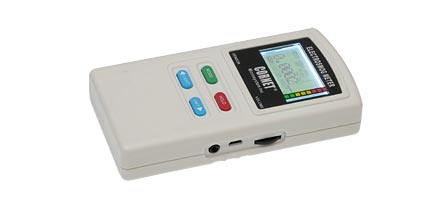
Cornet ED88Tplus
It measures electric and magnetic fields, as well as radio waves and microwaves (RF). RF is measured in milliwatts per square metre (mW/m2), so there are four digits to the right of the decimal point because the meter can measure down to 0.5 microwatts per square metre (µW/m2), equivalent to 0.0005 mW/m2. This requires some mental arithmetic when taking measurements. The location of the sensors on the meter is marked on the back. Radio and microwave waves are measured on the left-hand side when looking at the meter from the front. It is important to hold the meter in the correct orientation when measuring near a mobile phone mast. Magnetic fields can only be measured in one direction; the meter must be turned and rotated to find the maximum reading. There is no speaker for listening to microwaves, but there is a headphone jack. The volume is adjusted manually and the sound provides good guidance for locating the strongest radiation points. The headphone jack must be activated using the Light button.
Specifications Cornet ED88Tplus |
|
| Electric fields | |
| Frequency range | 50 - 50 000 Hz |
| Measuring range | 10 - 1000 V/m |
| Peak value | ? |
| Accuracy | 25 % |
| Magnetic fields | |
| Frequency range | 50 - 10 000 Hz |
| Measuring range | 0,01 - 60 µT |
| Peak value | ? |
| Three-axis | No |
| Accuracy | 20 % |
| Radio and microwaves (RF) | |
| Frequency range | 100 - 8000 MHz |
| Measuring range | 0,5 - 1 800 000 µW/m2 |
| Peak value | Yes |
| Accuracy | +/- 3,5 dBm |
| Sensitivity Peak | 0,5 µW/m2 |
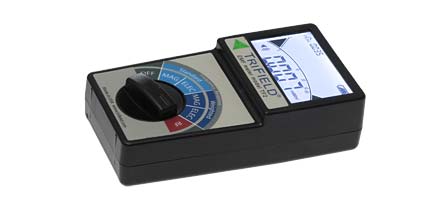
TriField TF2
It measures electric and magnetic fields, as well as radiofrequency (RF) radiation. These are selected using a robust dial. The meter gives a robust overall impression. As well as displaying numbers, the screen has a simulated pointer that effectively indicates sudden pulses.
The meter has an electric and magnetic field mode called 'weighted', in which measured values are increased within the 60 Hz to 1000 Hz frequency range. This provides an indication of the stronger currents created by higher-frequency fields in the human body. Above 1000 Hz, the adjustment decreases because, according to the manufacturer, biological reactions generally occur below this frequency.
The meter is American and magnetic fields are given in milligauss (mG). Divide the measurement by 10 to get microtesla (µT). Radio and microwave intensity is given in milliwatts per square metre (mW/m2) and is always displayed with three decimal places. If the decimal point is disregarded, the meter essentially displays microwatts per square metre (µW/m2), as there are 1000 µW/m2 in 1 mW/m2.
In areas with strong FM radio signals, the person holding the meter acts as an antenna, amplifying the reading. In such situations, it is recommended that the meter is held at a distance using a wooden rod.
±20% accuracy means that at 50 µW/m2, the meter can show values between 40 and 60 µW/m2. The sound function starts with a ticking noise and turns into a buzzing sound as the measured value increases. It is not possible to listen to radiofrequency radiation. Although the measurement range extends up to 6,000 MHz, the meter did not register any radar or Wi-Fi readings at 5,000–6,000 MHz; however, the sound function was slightly affected.
Specifications TriField TF2 |
|
| Electric fields | |
| Frequency range | 40 - 100 000 Hz |
| Measuring range | 1 - 1000 V/m |
| Peak value | Yes |
| Accuracy | +/- 4 % vid 50 Hz |
| Magnetic fields | |
| Frequency range | 40 - 100 000 Hz |
| Measuring range | 0,01 - 10 µT |
| Peak value | Yes |
| Three-axis | Yes |
| Accuracy | +/- 5 % at 50 Hz |
| Radio and microwaves (RF) | |
| Frequency range | 20 - 6000 MHz |
| Measuring range | 1 - 19 999 µW/m2 |
| Peak value | Yes |
| Accuracy | +/- 20 % at 1000 MHz |
| Sensitivity Average | 3 µW/m2 |
| Sensitivity Peak | 25 µW/m2 |
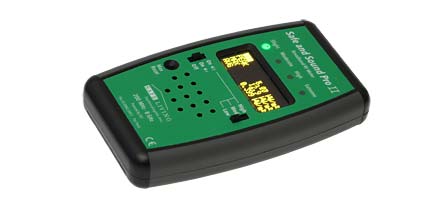
Safe and Sound Pro II
It only measures microwaves. The frequency range specified is smaller than that usually specified, for example on the meter. The specified accuracy applies within this smaller frequency range. The measurement range starts at an extremely low 0.001 µW/m², but there are already two caveats on the website. Measurements can be taken down to 0.005 µW/m², and the meter responds linearly to increased radiation intensity from 0.1 up to 1,000,000 µW/m². This means that the accuracy does not apply when the radiation intensity approaches the limits of the meter's measurement range. While the meter's sensitivity is very good, it is not as good as it first appeared. Radiation variations can clearly be heard in the speaker, which has automatic volume control that prevent changes in the sound level. Automatic volume control makes it difficult to use the sound function to identify the maximum level. The meter did not respond at all to radar at 5800 MHz.
Specifications Safe and Sound Pro II |
|
| Electric fields | |
| No | |
| Magnetic fields | |
| No | |
| Radio and microwaves (RF) | |
| Frequency range | 400 - 7200 MHz |
| Measuring range | 0,001 - 2 500 000 µW/m2 |
| Peak value | Yes |
| Accuracy | +/- 6 dB |
| Sensitivity Average | 0,000-0,005 µW/m2 |
| Sensitivity Peak | 0,005-0,020 µW/m2 |

Gigahertz HF59B
The meter is large. Even before you attach the green antenna, it is twice as long as the others. It is one of a range of meters developed for building biology activities aimed at reducing environmental risks that can, based on experience, endanger health. It only measures microwaves in the range from 700 MHz to 3,300 MHz. These specifications apply to the meter and antenna at the lowest price. Accessories such as additional antennas, filters, attenuators and amplifiers can increase the measuring range to 1,990,000 µW/m², improve sensitivity and extend the frequency range down to 27 MHz. Accuracy applies to the entire frequency range when using the 700–3300 MHz antenna. There is an audio function without automatic level control for listening to microwaves. It is a well-proven workhorse, but probably not the first choice for a first meter.
Specifications Gigahertz HF59B |
|
| Electric fields | |
| No | |
| Magnetic fields | |
| No | |
| Radio and microwaves (RF) | |
| Frequency range | 700 - 2700 (3300*) MHz with the standard antenna |
| Measuring range | 0,01 - 19 990 µW/m2 |
| Peak value | Yes |
| Accuracy | +/- 3 dB or +/- 5 digits |
| Sensitivity Average | 0,03 µW/m2 |
| Sensitivity Peak* | 0,04 µW/m2 |
|
* 3300 MHz with increased tolerance. |
|
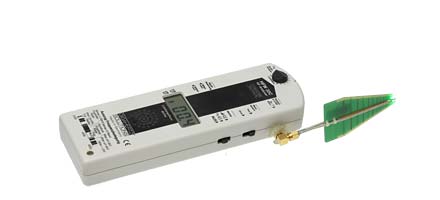
Gigahertz HFW35C
When higher frequencies such as 5 GHz Wi-Fi began to be used, Gigahertz designed the HFW35C. With accessories such as attenuators, amplifiers, and filters, the measurement range can be increased to 199,900 µW/m² and sensitivity improved. Additional filters can limit the measurement range to 5–6 GHz or above 3.3 GHz, preventing overlap with the HF59B's measuring range. The accuracy applies to the entire frequency range. The audio function enables you to listen to both a hum and the microwaves following the intensity of the radiation. The antenna is smaller than that of the HF59B because the increased frequency results in shorter wavelengths, allowing the antenna to be made smaller.
Specifications Gigahertz HFW35C |
|
| Electric fields | |
| No | |
| Magnetic fields | |
| No | |
| Radio and microwaves (RF) | |
| Frequency range | 2400 - 6000 MHz |
| Measuring range | 0,1 - 1999 µW/m2 |
| Peak value | Yes |
| Accuracy | +/- 6 dB or +/- 9 digits |
| Sensitivity Average | 0,1 µW/m2 |
| Sensitivity Peak | 0,4 µW/m2 |
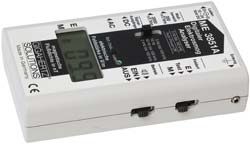
Gigahertz ME3851A
The Gigahertz ME3851A measures magnetic and electric
fields, which can be divided into the following frequency
ranges:
- 16 Hz (magnetic fields from railways)*
- 50 Hz and higher
- 2000 Hz and higher
It has signal output for logging measured values to an
external logger. With a lower limit of 0.0001 µT, the
measurement range is 10 times lower than that of any other
meter. However, magnetic fields are only measured in one
direction, so the meter needs to be turned and rotated to
find the maximum. This meter is ideal for those who
require the highest possible sensitivity to magnetic
fields from electrified railways and the power grid.
* Applies to Switzerland, Germany, Austria, Sweden and
Norway.
Specifications Gigahertz ME3851A |
|
| Frequency and measuring range | |
| Frequency range | 5 - 100 000 Hz |
| Measuring range electric fields | 0,1 - 1999 V/m |
| Measuring range magnetic fields | 0,0001 - 19,99 µT |
| Medelvärde RMS | Yes |
| Peak value | No |
| Peak value lock | No |
| Accuracy | |
| 5 - 400 000 Hz | - 2 dB |
| 50 Hz | +/- 2 % or 7 digits |
| Radio and microwaves (RF) | |
| No | |

Gigahertz NFA 400
The Gigahertz NFA 400 measures magnetic and electric fields, categorised by frequency range according to the TCO standard, as well as a few others. An accessory TCO disc is available for measuring electric fields in full accordance with the TCO standard. It has a logging function with 10 measurements per second for 36 hours without an external power source. Connectors are available to connect other meters to the logging function, such as the Gigahertz HF59B microwave meter. The logged data can then be processed using free downloadable software. Using coordinates from a GPS logger, the software can also create KML files, enabling measurements over large areas to be displayed in Google Earth Pro (which is also free). However, the meter is very expensive. It is ideal for those who want to go the extra mile. The measurements are displayed in nanotesla (nT), which is one thousandth of a microtesla (µT), making it more suitable for desired levels below 0.02 µT.
Specifications Gigahertz NFA 400 |
|
| Frequency and measuring range | |
| Frequency range | 5 - 400 000 Hz |
| Measuring range electric fields | 0,1 - 1999 V/m |
| Measuring range magnetic fields | 0,001 - 19,99 µT |
| Average trueRMS | Yes |
| Peak value | Yes |
| Peak value lock | Yes |
| Accuracy | |
| 50 / 60 Hz | +/- 5 % |
| 16 - 30 000 Hz | +/- 1 dBa |
| 5 - 400 000 Hz | +/- 2 dBa |
| Radio and microwaves (RF) | |
| No | |
| a 1 dB eaquels 25 %, 2 dB eaquels 60 %. | |
