Lethal doses
What happens above the limits?
The sun's rays provide a pleasant warmth, but only within certain limits. The same applies to its long-wave counterparts, radiofrequency radiation, which can heat us up deep down without us feeling the burning sensation. Our exposure limits for radiofrequency radiation, which is also known as radio waves and microwaves, protect us against the warming caused by this radiation.
Explanations can be found under the question mark at the bottom right.
The background to the experiments reported here is that reports emerged of eye damage, internal bleeding and temporary or permanent sterility among personnel exposed to radar radiation during the manufacture or use of radar. Radar radiation consists of high-intensity microwaves. As the major users of radar, the US Armed Forces needed an exposure limit. In 1957, the three branches of the US Armed Forces therefore launched the Tri-Service Program on the Biological Effects of Microwave Radiation. This was based on an exposure limit calculated by Herman Schwan, one of the leading biophysicists in the United States in the 1950s. According to Schwan's calculations, microwaves with an intensity of no more than 100 watts per square metre would protect against harmful heating. One question, of course, was whether microwaves had other effects besides heating.
Microwaves and X-rays compared to infrared radiation
Glands and sex hormones
A clear experiment involving male rats showed that irradiating the system of glands and sex hormones with microwaves produced the same results as irradiating it with X-rays. Zinc storage in the prostate decreased. This effect did not occur when the rats were heated using infrared radiation. The researchers conclude that the experiment demonstrates that the 'fault' lies with the pituitary gland in the brain.
The pituitary gland in the brain secretes the gonadotropin hormone, which the testicles use to produce testosterone. This testosterone is then used by the prostate to store zinc. If the pituitary gland does not secrete gonadotropin, this process does not begin. However, if the testicles and prostate are functioning properly, storage can occur when the correct hormones are injected. When gonadotropin was given to the testicles or testosterone to the prostate of the rats, storage functioned normally. Therefore, the pituitary gland had not secreted gonadotropin, which starts the chain reaction. This experiment demonstrates the importance of the pituitary gland, as it controls other glands.
The radiation used in the experiment was brutal, and the rats that were irradiated with microwaves for 10 or 15 minutes suffered obvious testicular damage due to heating, whereas those irradiated for only 5 minutes experienced fluid accumulation. In the five-minute group, the testicular temperature never exceeded 41 °C, yet hormone production was affected by the microwaves. The researchers then decided to test the effects of heating to 41 °C using infrared radiation.
No effect appeared. The experiment demonstrated that microwaves have effects other than heating.1
Testicular injuries
Male rats were used, this time with one group having their testicles heated using microwaves and the other group having their testicles heated using infrared radiation. The temperature of one testicle in each rat was measured during irradiation, which was interrupted when the temperature reached 30, 35, 37 or 38 °C. The other testicle was examined afterwards. The rats were sacrificed (killed) after one hour. All of the rats whose testicles had been heated to 35 °C or higher using microwaves showed signs of damage. The greatest damage was seen in the group whose testicles had been heated to 38 °C. No damage was observed in testicles heated with infrared radiation.
In a second round of experiments, rats were sacrificed after two days. Testicles heated with infrared had also suffered damage, but not as much as those heated with microwaves.2
Repeated irradiation
Passivity
In a preliminary study, rats were exposed to radiation at a frequency not reported, with an intensity of 1090 watts per square metre, for 15 or 30 minutes per day for three days. Immediately after each exposure, the rats were placed in a cage in which they had to press a lever to obtain food. Following each exposure, the time taken for the rats to press the lever increased. After the third day, some rats remained completely passive. On the fourth day, a one-month period began during which the rats had free access to food and no further exposure. After this month, the rats had returned to normal activity levels.3
The survivors died
Eight dogs were exposed in pairs to the same microwave radiation, at an intensity of 1,650 watts per square metre. One dog in the pair had never previously taken part in an experiment, while the other had survived one. Irradiation was interrupted when the temperature in the rear end of any of the dogs, as measured through the anal opening, reached 41.7 °C (107 °F). After 20 minutes, the irradiation was turned on again for a further 20 minutes, after which it was turned off again for 20 minutes. This sequence was repeated four times.
The survivors experienced greater difficulty in maintaining their body temperature, and two of them died shortly after the irradiation ended. None of the four dogs that had not previously been used died.4
The brain is tested
An article in the proceedings of the Third Tri-Service Conference summarises numerous experiments conducted on monkeys at frequencies around 390 megahertz. The monkeys' heads were fixed in various positions to investigate the effects of concentrated radiation on different parts of the brain. The intensity of the radiation was calculated to be 128 watts per square metre at the monkeys' skulls.
The monkeys would alternate between excitement and immobility. This pattern typically emerged within 60 seconds of the radiation being activated. This was followed by them staring and making rapid head movements from side to side. Finally, the monkeys became completely motionless and unresponsive to touch, pain, light and often sound.
A quick death or no effect
During one of these experiments, a monkey died after two minutes and 55 seconds. The longest experiment, which involved radiation from the side, lasted three hours with no noticeable effect.5
How animals succumb
Heating experiments were conducted on rats, rabbits, dogs and monkeys. Particular attention was paid to mapping the process in dogs from the moment the radiation was activated until they died from their body temperature reaching acute harmful levels.
Using radiofrequency radiation for heating did not always produce the same results as being in a room at 49 degrees. While radiation could increase body temperature in stages, an excessively high ambient temperature always caused a steady increase. It could also cause passivity, agitation, irregular breathing and pulse, and varying blood pressure.

Heatstroke
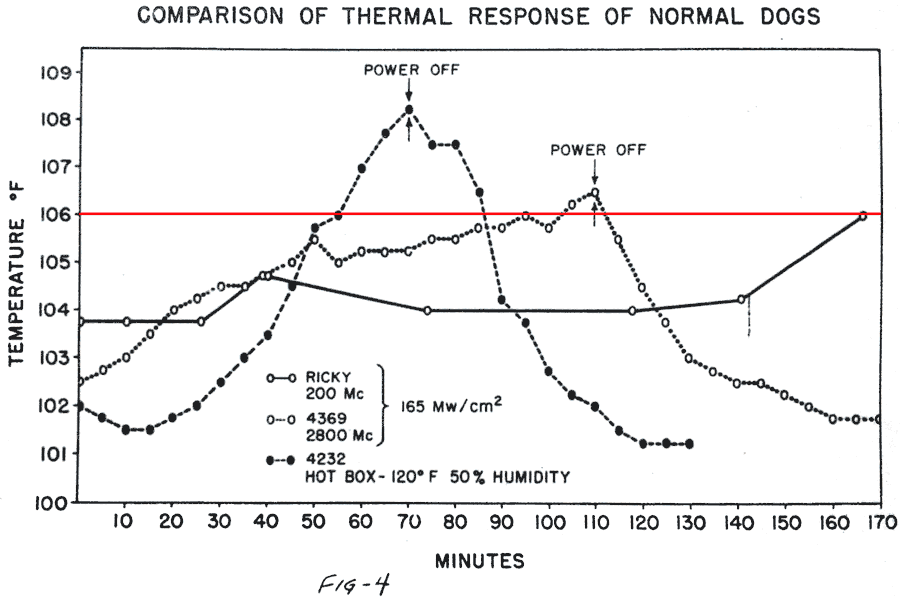
The effect of radiofrequency radiation on the body temperature of rats, rabbits and dogs was investigated at frequencies of 200 and 2,800 megahertz (MHz) with an intensity of 1,650 watts per square metre. During the experiments, the animals were able to move freely around in a Plexiglas cage, ensuring the radiation was distributed evenly over their bodies.6 The results were then compared to exposure in rooms with a controlled temperature of 48.9 °C and 50 per cent humidity.
During irradiation, heat does not always increase evenly over time. Depending on the species of animal, a state of equilibrium with a relatively constant body temperature can sometimes be reached. In the warm room, however, no equilibrium state occurred in any species of animal. Body temperature rises faster at 2800 megahertz than at 200 because the conversion of radiation energy into heat is more efficient at higher frequencies and shorter wavelengths.
Rats
2800 MHz: Critical
temperature reached after 20 minutes. No period of
equilibrium.
200 MHz: Critical
temperature was not reached after one hour. A period of some
equilibrium.
Rabbits
2800 MHz: Critical
temperature reached after 10 minutes. No period of
equilibrium.
200 MHz: Critical
temperature was not reached after 30 minutes. A period of
some equilibrium.7
Dogs
The equilibrium state, in
which body temperature remains relatively constant, is
particularly evident in dogs. The temperature increase can
be divided into three stages.
2800 MHz pulsating
radiation:
- Relatively rapid increase of 2-3 °C over 1/2 to 1 hour.
- Equilibrium state with a body temperature varying between 40.5 and 41 °C for 1 hour.
- Temperature regulation breaks down, causing body temperature to quickly reach critical levels.8
200 MHz: Stage 1 takes a little longer. Stage 2 lasted an average of five hours before Stage 3 began. A small dog weighing 4 kg reacts in the same way as a larger dog.
Radiation directed at the head
In a series of experiments, the radiation source was placed five centimetres from the dogs' skulls and emitted an intensity of 8,000 watts per square metre, as measured at the dogs' scalps. The frequency was 2,450 megahertz of continuous radiation, with no pulses. Ten dogs died after 2.5–6.5 hours of irradiation. Now, the heart rate, blood pressure and breathing of two dogs were to be studied. The two dogs were anaesthetised and did not die during the experiment. The effect of radio wave irradiation is affected by sedatives, relaxants or anaesthetics. In anaesthetised dogs, body temperature does not reach a distinct equilibrium; instead, it rises relatively evenly to a critical level.

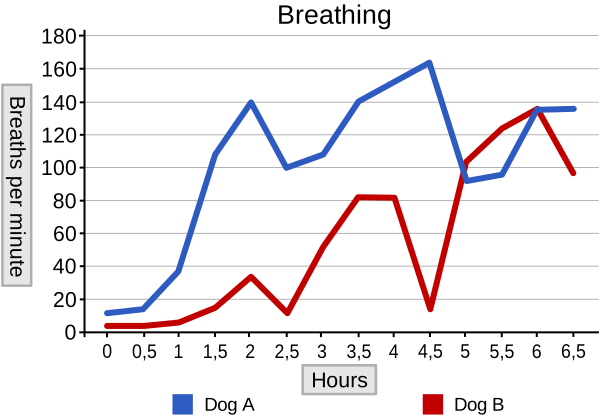
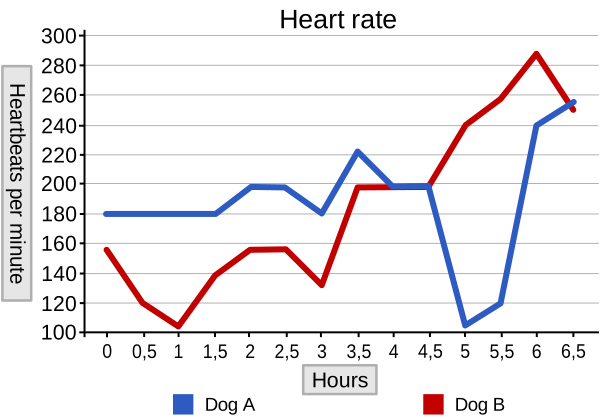

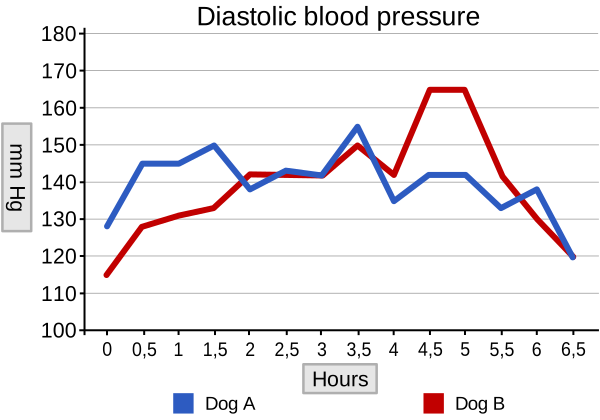
The researchers made a comment about the final drop in
blood pressure.
— A decrease in blood pressure without a corresponding
decrease in heart rate can indicate a reduction in the
heart's pumping capacity, vasodilation, a reduction in blood
volume, or a combination of these factors. This shock-like
development occurred without any visible signs of
convulsions.9
The breakdown of temperature regulation was explained by the impaired thermostat function of the hypothalamus due to increased body temperature.10 However, no one seriously tested whether this breakdown can occur without the temperature reaching 41 °C. A diagram suggests that this may be the case.11
Unanswered questions
The exposure limit of 100 watts per square metre was never tested. All the experiments reported at the Fourth Tri-Service Conference were conducted either at an elevated body temperature or with radiofrequency radiation at an intensity that causes heating. However, some experiments demonstrated other effects than of heating. The Air Force department responsible for protecting its own personnel was concerned about this, and its representative asked a series of questions during the final presentation.
- Why is dose not treated in the same way as in chemistry and ionising radiation, with a time factor?
- What is the recovery time after radiation?
- Reports have been presented indicating effects other than warming. Could the nervous system be affected purely electrically?
- Which bodily functions can be affected or altered, and which are most at risk?12
These questions are as relevant today as they were in 1960. Some of the answers are now available, but none of them have been given a clear response that can be used to set exposure limits or apply the precautionary principle.
